Казахстанец Денис Желнин на велосипеде доехал до базового лагеря Эвереста
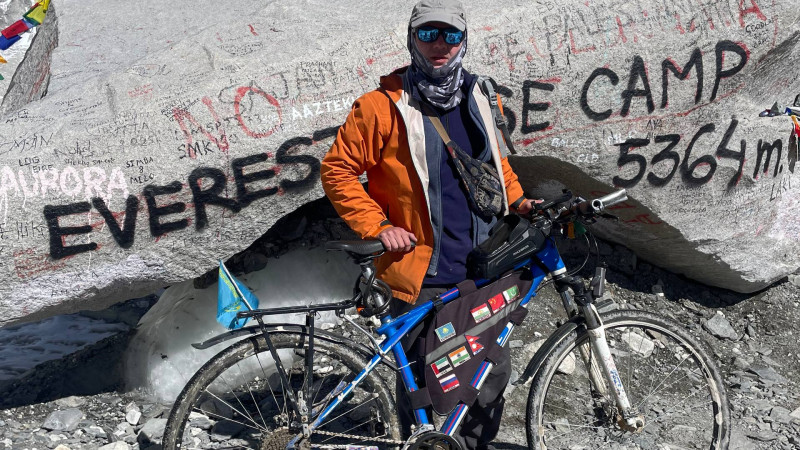
35-летний казахстанец Денис Желнин embarked on an extraordinary cycling journey from Almaty to the base camp of Everest. Over the course of thousands of kilometers and six countries, he faced snow, rain, mountain passes, and heights where oxygen is scarce.
Born in Pavlodar and raised in Ekibastuz, Денис spent the last four years before his adventure living in Almaty. His love for cycling began about 11-12 years ago when he and his friends would often rent bikes. Eventually, many of them bought their own, prompting Денис to do the same.
"We often rented bikes with friends. Over time, many bought their own, and I decided it was time for me too. At that moment, I had no idea how deeply this would become a part of my life," — he recalls.
Before discovering cycling, Денис had little interest in traveling and struggled to learn to ride as a child. However, once he mastered it, he quickly surpassed his peers with tricks like riding without hands.
The first longer rides began about ten years ago, initially spanning just one or two days, covering 20-50 kilometers. As his confidence grew, he began to venture out alone.
"When I started to increase the distances, I rode solo. My first hundred-kilometer day was from Pavlodar to Aksu and back across an old bridge. It took a lot of preparation, and I was scared. Later, I rode 150 kilometers from Pavlodar to Ekibastuz, which felt like a personal achievement," — he shared.
This sparked a desire for bigger adventures, like cycling from Pavlodar to Almaty. He recalls feeling overwhelmed by the idea, akin to going to another planet.
"I researched and prepared for it. My first solo trip was from Pavlodar to Bayanaul: 240 kilometers in 13 hours," — Денис explained.
In two weeks, he cycled 1,800 kilometers from Pavlodar to Almaty. This was followed by trips to Kyrgyzstan, the Pamirs near Tajikistan, Altai, and the Chuysky Tract up to the border with Mongolia.
Inspiration for the Journey
Denис’s idea to cycle to Everest emerged one winter after years without significant adventures.
"I wanted something truly epic, not just a hike," — he admitted.
After exploring various routes in Kazakhstan, Russia, Kyrgyzstan, and Tajikistan, nothing sparked his interest until Everest came to mind.
"Just cycling for the sake of cycling would bore me; I would quit after three days," — he confessed.
His love for mountains and the desire to see the peak firsthand set a new ambitious goal. The thought of reaching the base camp by bicycle felt both daunting and enticing.
"The scale of the idea made me realize this was the level of epicness I was looking for," — he added.
Preparation for the journey took about six months. Though he could have organized everything in a couple of weeks given his experience, he chose to take his time.
Денис meticulously checked the route, mountain passes, visas, and borders. Most of his gear was already in place, but he needed to purchase some additional items, ensuring everything was suited for thousands of kilometers and extreme conditions.
Family Concerns and Fear of the Unknown
Denис's parents were not thrilled with his ambitious plan, having grown accustomed to his shorter and safer trips.
"Especially when I mentioned I'd be crossing the highest mountain ranges in the world. But when I showed them photos and videos from those areas, they calmed down a bit. They thought I would venture into the wild, but I planned to stick to main roads," — he recounted.
Despite their discouragement, Денис was determined to embark on the journey.
"I was ready to leave at any cost," — he said.
His primary fear before setting off was the uncertainty ahead.
"I knew this wasn't just a hike but a different way of life for a long period. I was scared to leave my comfort zone for something completely new, uncertain, and risky," — he explained.
Yet, the desire for an epic adventure outweighed his fears, and he pushed through his doubts.
The Journey Across Six Countries
The trip spanned thousands of kilometers and included six countries:
- Kazakhstan — the starting point;
- Kyrgyzstan — crossed entirely;
- Tajikistan — traversed the highest section of the Pamir Highway;
- China — a short segment;
- Pakistan — the entire Karakoram Highway in Gilgit-Baltistan;
- India and Nepal — the final stretch of the journey.
Due to visa complications, Денис temporarily left his bicycle in Islamabad and flew to India via Dubai, which was the simplest and cheapest option. He later returned overland through the only border crossing between India and Pakistan — Wagah.
"After returning to Islamabad, I took my bicycle and continued my journey back to India, again through Wagah," — he noted.
While in India, he spontaneously decided to visit Goa — an additional 2,500 kilometers in the opposite direction — just to meet friends and see the ocean.
"It was great to reconnect with friends in Goa, whom I hadn't seen in a long time, and I met some Russian guys in Islamabad with whom I still keep in touch," — he said.
His next destination was Nepal, where he tackled the famous Annapurna circuit trek — one of the most stunning routes in the world. It was here that he truly experienced the rainy season.
"It rained day and night, causing landslides and floods; electricity and internet went out for days. My clothes were always wet, and the water was freezing. The constant cold was exhausting, but I never thought about quitting the journey," — he reflected.
After completing the Annapurna trek, he reached Kathmandu and began his ascent to the base camp of Everest — the highest point of his adventure.
Challenges of Altitude
The physically toughest part of the journey was the climb to Kalapatar.
"At 5,600 meters, the oxygen level is 60% lower than at sea level. Climbing with the bike was incredibly hard: stairs, snow, and every step was a struggle. Movements were slow, thoughts were sluggish, and steps tiny. Just a few quick steps would make me dizzy and breathless," — Денис described.
Accommodation During the Journey
In the early days of his journey, Денис often camped. However, after entering Pakistan, around 80% of his nights were spent in hotels.
"Pakistan, India, and Nepal are densely populated countries, and it can be challenging to find a quiet spot to camp. However, there are many affordable hotels and lodges around," — he shared.
Daily Life on the Road
Денис’s days varied, but they generally fell into two categories:
First — days of active travel.
"Breakfast, hop on the bike and go. Sometimes I would stop to admire the scenery, occasionally to capture content, or for lunch. Then I’d search for a place to sleep — in a tent, a hotel, or wherever I could find. After dinner, I would watch a movie and sleep," — he recounted.
Second — days spent staying in a village or town for a week or even a month.
"During these times, I wouldn’t explore many attractions; instead, I often frequented the same cafes to work, walked the same streets, and soaked up the vibe as if I had lived there for ten years," — he reflected.
Visa Challenges
Denис explained that most visa issues were resolved on the go. He set off without all the necessary documents but was confident he could manage everything en route.
"I realized there was no point in delaying my departure just because I didn’t know how to get a visa for Pakistan. I left without some visas, but things worked out along the way. In Osh, a hostel provided a contact for a pass to GBAO, in China, I learned how to apply for a Pakistani visa online, and I obtained my Indian visa while in Pakistan. Sometimes I had to act on instinct, but everything fell into place," — he said.
Dangerous and Challenging Moments
Throughout his travels, Денис encountered several dangerous situations that required him to stay alert.
"In Goa, I cut my leg with a knife. In India, I rode a motorcycle for the first time and traveled 3,000 kilometers but crashed — fortunately, the injuries were superficial. On the Annapurna trek, I found myself on a narrow path above a cliff at night, at an altitude of 4,200 meters, with low oxygen levels. Panic could have set in, but I slowed down and proceeded cautiously," — he recounted.
He faced few serious issues with his bicycle.
"There were flat tires, worn brakes, and by the end, my racks fell apart, and the frame now has two holes, but it’s not critical," — he noted.
Overall, he felt comfortable in most regions.
"Especially safe in Gilgit-Baltistan (Pakistan). The people are simple and welcoming, and they don’t lock their homes. In Balochistan, there are occasional terrorist threats, but tourists are accompanied by police, which doesn’t hinder travel," — he shared.
Solitude and the Finish Line
For much of his journey, Денис traveled alone and felt comfortable doing so. However, by the end, he recognized his personal limits regarding solitude.
"At first, I was fine being alone, but by the end of the trip, I reached my threshold for comfortable solitude. My emotions were mixed: excitement at reaching Everest and a slight emptiness from achieving my goal," — he noted.
Life After Everest
Денис expressed that long distances now seem much more manageable.
"Previously, 100 kilometers felt like a significant event that required mental preparation. Now, I can cover 1,000 kilometers in ten days if I have the desire and time. Shorter trips don’t appeal to me anymore," — he emphasized.
He concluded that it all comes down to desire and intent.
"If a person wants to do something, they will. If they don’t, then they probably don’t want it badly enough. My advice is to start with a small trip, train, and then aim for something great," — he concluded.
- Сравнение отелей
- Обзоры отелей
- Популярные направления
- Советы по бронированию
- Отели для всех
- Тематический отдых
- Лайфхаки туристов
- Путеводители
- Сервисы и удобства
- Будущее отелей
- Владельцам отелей
- Командировочным
- Туристам
- Новости индустрии
- Акции и скидки
- Лучшие предложения
- Кругосветка
- Долгосрочное проживание
- Аренда жилья
- Путешествие с детьми
- Отели и отдых в Казахстане
- Достопримечательности Казахстана
- Отдых на Каспии
- Горнолыжный отдых в Казахстане
- Экотуризм и отдых на природе
- Санатории и лечебные курорты Казахстана
- Путешествия по Казахстану на авто
- Лучшие отели для командировок по Казахстану
- Бюджетный отдых в Казахстане
- Где отдохнуть в Казахстане с детьми?
- Путешествия за границу
- Визовые вопросы для казахстанцев